How much does a Pacific horizon outside your window really add to a Pebble Beach home’s price? If you’re buying or selling here, that question matters because views are both emotional and financial. You want clear guidance grounded in local realities, not generic coastal guesses. In this guide, you’ll learn what drives view premiums in Pebble Beach, how to categorize your view, and practical ways to estimate the value. Let’s dive in.
Why ocean views command premiums in Pebble Beach
Pebble Beach is an affluent, low-density coastal community with limited developable land and high demand for scenery, privacy, and prestige. Many buyers are out-of-area or purchasing second homes, which increases willingness to pay for memorable views. When the right buyer meets the right view, prices respond.
Inventory is often tight, and truly superior view properties are scarce. That scarcity magnifies premiums, especially when comparable sales are limited and competition pushes prices higher. Homes with strong, well-framed ocean views also tend to sell faster, which can support higher contract prices.
Lenders and appraisers recognize view value when it is well-documented. If appraisers can find nearby sales that clearly demonstrate a view premium, they can justify higher financed values. That documentation is most convincing when the view is clearly categorized and supported by local comps.
What type of view you have matters
View quality hierarchy
Not all ocean views are created equal. Buyers and appraisers distinguish among categories that signal very different price impacts:
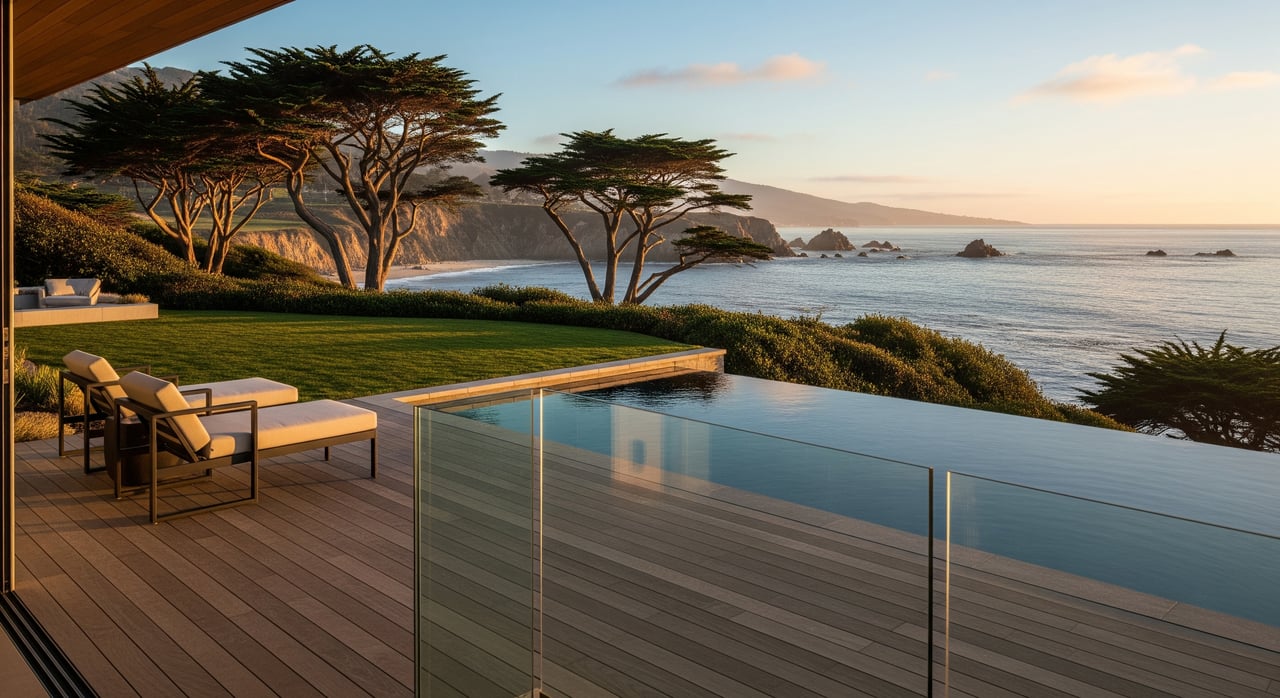
- Oceanfront: Immediate shoreline adjacency, often with dramatic sightlines.
- Coastal bluff or unobstructed panoramic ocean view: Elevated vantage with wide coastline exposure.
- Partial or filtered ocean view: Glimpses from certain rooms or angles, sometimes distant.
Generally, panoramic and unobstructed coastline views command more than partial or distant views. Views that include iconic landmarks, such as Pebble Beach Golf Links, Carmel Bay, or Point Lobos, can carry additional prestige and value recognition.
Elevation, orientation, and privacy
Higher elevations that open up wider horizons typically price stronger than low, limited vantage points. West or southwest orientations that capture sunsets are often preferred. Privacy and low road noise boost desirability because they allow you to enjoy the view without distraction.
Permanence and protection
The risk of future obstruction reduces a view’s premium. Recorded view easements, protected open space, or clear view corridors help preserve value by increasing certainty that the view will last. Local zoning and conservation overlays can also limit future building that might block a view.
How much views add to price
Published analyses of coastal markets report a wide range of premiums for views, from modest single-digit percentage adjustments to much larger premiums for exceptional, panoramic, or direct oceanfront properties. In Pebble Beach, where baseline prices are higher, even a modest percentage premium can represent a very large dollar amount. The most reliable way to quantify the impact for a specific property is to analyze recent local sales that differ primarily by view quality.
Estimating the premium for your property
Comparable sales approach
Start with recent Pebble Beach sales that match your home on lot size, square footage, age, condition, and key amenities. Then separate the influence of the view by adjusting for differences like bedrooms, baths, and updates. The remaining price gap between a view home and a similar non-view home is the implied premium.
Paired-sale analysis
When possible, identify two very similar homes that sold recently where the view is the major difference. The price difference between those sales points to the value of the view. The closer the match, the more reliable the estimate.
Hedonic regression
For a larger data set, a statistical model can isolate the marginal contribution of a view while controlling for other factors. This method requires expertise and robust data, but it can be helpful when comps are thin or varied.
Appraisal practice
Appraisers primarily use the sales comparison approach and may rely on paired sales and percentage or dollar adjustments for different view levels. They weigh view permanence, orientation, and market recognition. If financing is involved, lenders will expect a documented rationale with nearby comps.
Practical tools and data
Use local MLS history and Monterey County parcel records to verify sales, lot specifics, and recorded easements. GIS and elevation tools help you evaluate view lines and long-term permanence. For risk context, consult coastal planning resources that discuss erosion, sea-level rise, and storm impacts. Combine these inputs with on-site observation at different times of day.
Value offsets to weigh
Coastal hazards and insurance
Sea-level rise, coastal erosion, bluff stability, and storm surge risks can weigh on premiums for low-lying or bluff-front properties. Some homes may carry higher insurance or mitigation costs. Buyers increasingly consider long-term exposure when assigning value to a view.
Maintenance and exposure
Salt air and wind can accelerate wear on roofs, exterior finishes, and mechanical systems. Landscaping and vegetation management to preserve view corridors can add ongoing costs, especially if protected vegetation is involved.
Marketability and cycles
Iconic views often attract multiple offers in strong markets. In slower cycles, buyers may prioritize practicality, and view premiums can compress. Liquidity for niche properties can also vary with broader market conditions and financing norms.
Seller playbook to maximize a view
- Define your view category clearly in marketing. Use precise language such as unobstructed panoramic ocean view or partial ocean view from primary living spaces.
- Lead with presentation. Professional staging, photography, videography, and drone panoramas can capture breadth, depth, and sunset orientation.
- Time your media. Twilight shoots and clear-weather days showcase color and horizon lines that photos cannot replicate on overcast days.
- Frame permanence. If you have view easements or protected open space nearby, feature those facts in your materials.
- Prep for appraisals. Provide a comp package that highlights view differences and recent closings with similar view quality.
- Consider pre-listing projects. Strategic updates coordinated through a concierge approach can amplify the overall impression that supports your view premium.
Buyer checklist to judge a view premium
- Visit at different times. Compare morning, afternoon, and sunset angles for glare, fog, and color.
- Study sightlines. Use maps and elevation data to assess potential future obstructions. Ask about recorded view easements and local zoning.
- Balance the numbers. Think in both percent and dollars. In a high-price area, even modest percentages translate into meaningful money.
- Weigh risks and costs. Factor coastal hazards, insurance, and maintenance into your long-term ownership budget.
- Validate with comps. Ask your agent for recent paired or closely matched sales that isolate the view’s contribution.
- Plan for appraisal. If financing, make sure the premium you’re paying can be supported by documented local sales.
The bottom line for Pebble Beach pricing
In Pebble Beach, ocean views are more than a backdrop. They are a core amenity that influences buyer demand, time on market, and final price. The size of the premium depends on view quality, permanence, orientation, privacy, and how convincingly those factors are supported by local comps. With careful analysis, you can quantify the impact and make confident decisions.
If you want help estimating what your view is worth or how much to pay for one, our family-run team pairs deep local knowledge with premium presentation and project-managed support. Reach out to Homes by Henson to start a clear, data-backed plan.
FAQs
How much more do ocean views add in Pebble Beach?
- It varies widely by view quality, permanence, and comps, with coastal studies showing ranges from modest single-digit percentage impacts to much larger premiums for exceptional or oceanfront properties; local comparable sales provide the best estimate.
Do partial ocean views still add value in Pebble Beach?
- Yes, partial or filtered ocean views typically add value, though less than unobstructed panoramic views, and the premium scales with clarity, breadth, and permanence.
How do appraisers treat ocean views in Pebble Beach?
- Appraisers use sales comparison and paired sales to support view adjustments and consider orientation, privacy, and view permanence, with lender acceptance tied to well-documented local comps.
Can a view premium drop if a neighbor builds?
- Yes, the risk of future obstruction reduces today’s premium, while recorded view easements, protected open space, or strict zoning can help preserve value over time.
What should sellers highlight to maximize a view premium?
- Showcase the view with staging, professional photography and video, drone panoramas, clear view categorization, and documentation of any easements or protections, plus a comp package that isolates view value.